Your slides are done. Now what do you actually say?
Most thesis students spend weeks perfecting their slides. Then the week before their defense, they panic. The slides look great — but the words won't come.
Bullet points don't help when you're standing in front of a panel of professors. Neither does "winging it." What you need is a complete, word-for-word speaking script — one that tells you exactly what to say on every single slide.
This guide walks you through how to write that script, slide by slide. Whether your defense is 15 minutes or 45 minutes, the structure is the same.
Title defense vs thesis defense: what's the difference?
A research title defense happens before your study begins: you present a proposed title and defend why the research is worth doing. A thesis defense happens after the work is finished, when you present what you actually found. A title defense is also usually delivered by a group, with a moderator opening the session, rather than by one candidate alone.
This guide covers the thesis defense. A title defense follows a different structure: background and problem, research question, objectives, proposed methodology, significance, and references — no results, no discussion, because there are no findings yet.
Should you use a full script or just bullet points?
A common piece of advice is "don't read from a script — it sounds robotic." That advice is for experienced speakers. For a thesis defense, a full script is actually the smarter choice.
Here's why:
- You control your timing. A written script lets you calculate exactly how long each slide takes. No more running over — or finishing 10 minutes early.
- You choose every word in advance. Under pressure, your brain goes blank. A prepared script means you never lose your place.
- It's expected. Most examiners know candidates prepare scripts. A well-rehearsed script that sounds natural is far better than an unrehearsed ad-lib that rambles.
- You can rehearse to perfection. The goal isn't to sound scripted on the day — it's to rehearse until the words feel natural. The script is a rehearsal tool, not a crutch.
The key is writing a script that sounds like speech, not an essay. Short sentences. Conversational language. Words you'd actually say out loud.
How long should a thesis defense script be?
A good rule of thumb: ~110 words per minute of slot time. That is lower than raw speaking speed on purpose — a real defense includes pauses, transitions and breathing room, and this figure already accounts for them.
| Defense length | Target word count | Approximate slides |
|---|---|---|
| 15 minutes | ~1,650 words | 10–12 slides |
| 20 minutes | ~2,200 words | 12–15 slides |
| 30 minutes | ~3,300 words | 18–22 slides |
| 45 minutes | ~4,950 words | 25–30 slides |
Divide your total word count by your number of slides to get a per-slide target. A 20-minute defense with 15 slides means roughly 147 words per slide. Some slides will be longer (methodology, results) and some shorter (title slide, transitions).
These figures already allow for pauses, transitions, and a natural speaking pace — don't cut another 10% on top. If you tend to speak slowly under pressure, rehearse with a timer and trim only if your run-throughs actually go over.
Slide-by-slide script guide
Every thesis defense follows roughly the same structure. Here is what to say on each type of slide — with example script lines you can adapt.
Slide 1 — Title slide
This is your 30-second opening. Your goal here is not to impress — it's to ground the room and settle your own nerves. Keep it short and confident.
What to cover:
- Your name and degree program
- The full title of your thesis
- A one-sentence preview of what the presentation covers
Example script:
"Good morning. My name is [Your Name], and today I'm presenting my [Master's / PhD] thesis titled [Title]. Over the next [X] minutes, I'll walk you through the research question that motivated this work, the methods I used to investigate it, and the key findings and their implications."
That's it. Don't add more. The panel already has your thesis — they don't need a second abstract.
Slide 2 — Introduction and background
This is where you set the scene. You're answering one question: why does this research matter?
What to cover:
- The broader context of your field
- The specific problem or gap your research addresses
- Why solving this problem matters — practically or academically
Example script:
"[Field] has seen significant growth over the past decade, but one area that remains poorly understood is [topic]. Existing research has largely focused on [X], leaving a gap in our understanding of [Y]. This gap matters because [real-world consequence or academic significance]. My thesis addresses this directly."
Avoid jargon here. The panel knows your field — but this section sets the tone for your whole presentation. Clarity first.
Slide 3 — Research question and objectives
This is the most important slide in your entire defense. Be direct. State your research question in one sentence. Then list your objectives.
Example script:
"The central question guiding this research is: [your research question]. To answer this, I set out three specific objectives. First, to [objective 1]. Second, to [objective 2]. Third, to [objective 3]. I'll address each of these in turn."
Slow down on this slide. Let the panel absorb the question. This is the anchor they'll return to throughout your defense.
Slide 4 — Literature review
The literature review slide is a summary, not a bibliography reading. Your job is to show you understand what came before — and where your work fits.
What to cover:
- Two or three key themes or debates in existing literature
- What those studies found
- The gap or limitation that your research fills
Example script:
"Previous research in this area has explored three main threads. [Author, Year] demonstrated that [finding 1]. Building on this, [Author, Year] found that [finding 2]. However, these studies share a common limitation: [gap]. None of them examined [your specific focus], which is precisely where my research contributes."
Don't try to cover every source. Three to five key works, clearly synthesized, is far more impressive than a rushed list of 20 citations.
Slide 5 — Methodology
Panels ask the most questions here, so your script needs to be rock-solid. Explain what you did, why you chose that approach, and what limitations it has. Acknowledging limitations yourself shows intellectual honesty — and disarms committee questions before they ask them.
What to cover:
- Research design (qualitative, quantitative, mixed)
- Data collection method (surveys, interviews, experiments, secondary data)
- Sample or dataset description
- Analysis approach
- One key limitation and how you addressed it
Example script:
"To answer the research question, I used a [qualitative/quantitative/mixed] design. Specifically, I [collected data via / conducted / analysed] [describe method]. The sample consisted of [describe sample — size, characteristics, selection criteria]. I analysed the data using [method], which was appropriate here because [reason]. One limitation worth noting is [limitation]. To mitigate this, I [mitigation strategy]."
Slide 6 — Results and findings
This is where you present what you actually found. Don't just describe your charts — interpret them. Tell the panel what the numbers or themes mean.
What to cover:
- Your main findings, organized by research objective
- What each finding shows (not just what it is)
- Any unexpected results — and why they might have occurred
Example script:
"Turning to the results. In relation to my first objective — [objective 1] — I found that [finding]. This is shown in [chart/table] here. What this tells us is [interpretation]. With respect to my second objective, [finding 2], which was [expected/unexpected] because [reason]."
Use transition phrases to link findings to objectives. This shows the panel you've kept your research question at the center throughout.
Slide 7 — Discussion
Many students treat the discussion as a repeat of the results. It isn't. The discussion answers: so what?
What to cover:
- How your findings connect to the literature you reviewed
- Where your results agree or disagree with existing work — and why
- The theoretical or practical implications of your findings
Example script:
"These findings have several important implications. First, they support [Author]'s argument that [claim], and extend it by showing [new insight]. Second, they challenge the assumption in [Author]'s work that [assumption]. This suggests that [new understanding or framework]. In practical terms, this means [real-world implication]."
Slide 8 — Conclusion
Your conclusion should feel like a landing, not a crash. Bring the panel back to your original research question and show that you answered it.
Example script:
"In conclusion, this research set out to answer the question: [research question]. Through [methodology], I found that [summary of key findings]. These findings contribute to the field by [contribution]. They also have practical implications for [audience]. Looking forward, future research could explore [one or two clear directions]. I believe this work [brief statement of significance]."
End with a full stop, not a trailing off. Confidence in your closing leaves the strongest impression.
Q&A preparation — beyond the slides
The Q&A is not part of your scripted presentation, but you can still prepare for it. Write out answers to the five hardest questions you can imagine the panel asking. Practice saying them aloud.
Common panel questions include:
- "Why did you choose this methodology over [alternative]?"
- "How do you account for [specific limitation]?"
- "How does your work relate to [specific study they know]?"
- "What would you do differently if you were starting again?"
- "What are the next steps for this research?"
Having written answers — even if you never read them — trains your brain to recall the key points naturally under pressure.
5 tips for delivering your script naturally
- Rehearse out loud, not in your head. Reading silently and speaking aloud use different parts of your brain. Only spoken rehearsal builds the muscle memory you need on the day.
- Record yourself once. One recording reveals more than hours of silent re-reading. You'll immediately hear where you rush, where you mumble, and where the pacing feels wrong.
- Mark your script for pauses. Add a "//" wherever you want to pause for emphasis or to let a point land. Pausing is not weakness — it's control.
- Don't memorize — internalize. The goal isn't to remember every word. It's to understand every section so well that you can express it naturally even if you forget the exact phrasing.
- Know your first three sentences perfectly. The opening is the hardest moment. Once those three sentences are out, your nerves settle and the rest flows.
How to generate your thesis defense script automatically
Writing a word-for-word script for a 20-minute defense takes most students four to six hours. It's one of the most overlooked steps in defense preparation — and one of the most stressful.
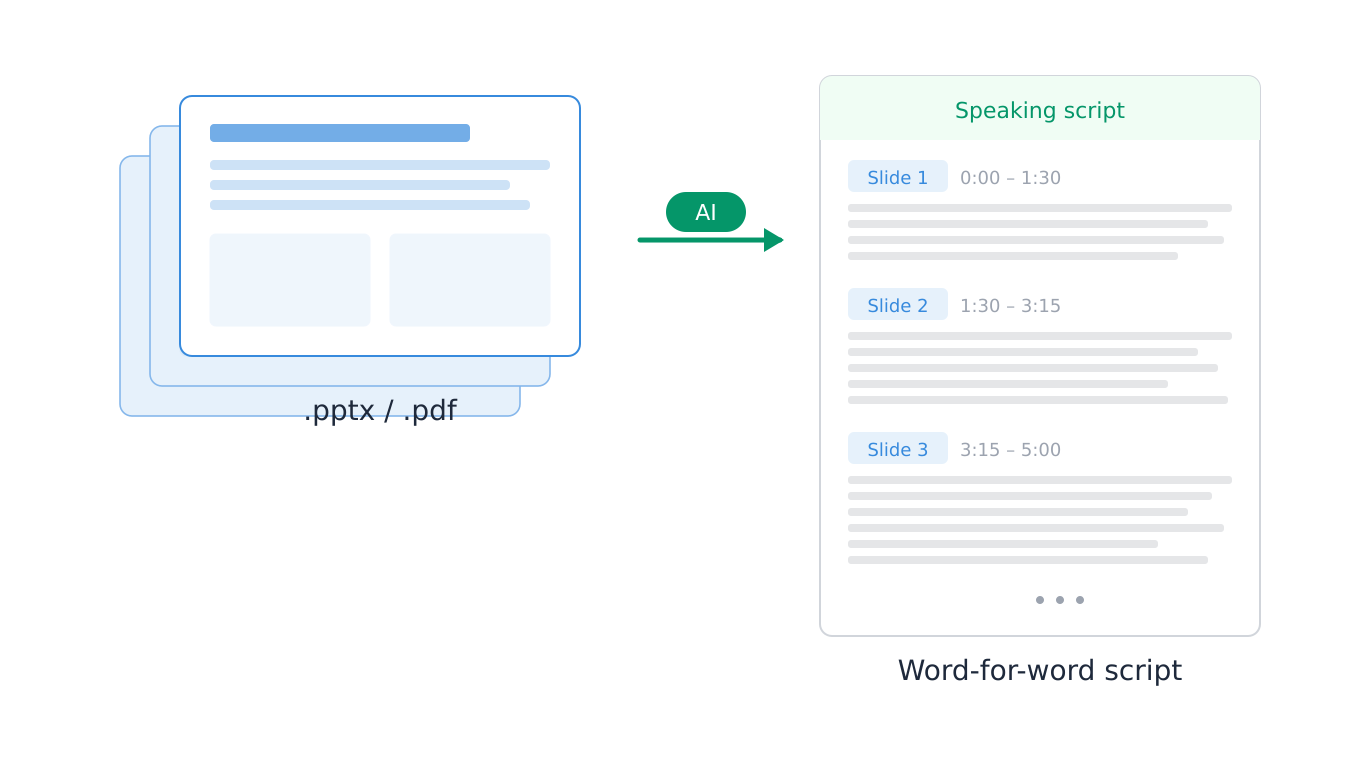
SlideScript automates this step. Upload your thesis defense PDF, set your total defense duration, and it generates a complete speaking script — timed slide by slide, written in natural spoken English, and ready to rehearse from.
It works in 34 languages, so whether your defense is in English, Mandarin, Spanish, Arabic, or another language entirely, you get a script matched to your audience.
The free tier requires no signup. Upload your slides, get your script, and start rehearsing — in the time it would have taken to write your introduction slide by hand.