You know your material. You have rehearsed the slides. Then you stand up, open your mouth, and the word you needed is simply not there. You reach for something clumsier, lose the shape of the sentence halfway through, and spend the next slide recovering instead of presenting.
If English is not your first language, that is the specific thing you are managing. Not weak preparation, and not weak expertise. It is the gap between the English you read and write comfortably and the English you can produce out loud, under pressure, while also tracking a clock and a room full of faces.
Most advice for this situation stops at "slow down and breathe". That is not wrong, but it treats the whole problem as nerves. A lot of it is not nerves. It is load. Speaking a second language takes more working memory than speaking your first, and a presentation already consumes most of what you have available. So the useful move is to shift as many decisions as possible off the stage and into your preparation, where you have time to make them properly.
Which means writing a real script. Not bullet points you will improvise around, but the actual words.
Why the usual advice does not go far enough
Tips like "use simple language" and "practise a lot" are true and almost impossible to act on, because they do not tell you what to simplify or what to practise. You cannot simplify vocabulary you have not chosen yet.
A written script turns vague advice into specific decisions you can make once and then stop worrying about. Every hard word gets picked in advance. Every long sentence gets shortened at your desk instead of collapsing mid-delivery. By the time you present, the language questions are already answered, and the only thing left to do is speak.
Write the script for your mouth, not for the page
The single most common mistake is writing a script that reads beautifully and speaks terribly. Written English tolerates long subordinate clauses, formal connectors and dense noun phrases. Spoken English does not, and spoken second-language English really does not.
The test is simple: read every sentence aloud at normal volume. If you run out of breath, stumble, or have to restart, the sentence is wrong. It does not matter that it is grammatically perfect. Rewrite it until you can say it cleanly on the first attempt.
Some conversions that almost always help:
"Our findings demonstrate a significant correlation between the two variables" becomes "We found a strong link between the two. Here is what that means."
"It is important to note that" becomes "Note that", or simply nothing.
"Subsequently" and "furthermore" become "then" and "also".
None of this makes you sound less capable. Short, direct sentences read as confidence in any language.
Choose words you can say under pressure
There is a difference between words you know and words you can retrieve reliably while your heart rate is elevated. Under load, retrieval fails first. So build your script out of words that survive that.
Go through your draft and mark every word you would not want to attempt in front of a room. Long multi-syllable words are the usual suspects: "approximately", "significantly", "methodology", "entrepreneurship", "specifically". Most of them have a shorter alternative that means the same thing.
"approximately" becomes "about"
"significantly" becomes "much" or "far"
"utilise" becomes "use"
"in order to" becomes "to"
Then deal with the words you cannot replace. Every field has terms that have no simple substitute, and yours will appear in your script whether you like it or not. Pull those out into a short list and practise them on their own, out loud, ten times each, until they are muscle memory rather than a decision. It is a five-minute job and it removes most of the moments where a presentation visibly wobbles.
Keep sentences short enough to finish
A sentence you cannot finish is worse than a simple one. When a long sentence goes wrong halfway through, you have to either abandon it, which sounds uncertain, or push through a grammatical structure you have already lost control of.
Aim for one idea per sentence. If a sentence has two "and"s or a "which" in the middle, split it. Full stops are free, and they give you legitimate places to breathe.
Short sentences also help your audience. In any mixed-language room, some listeners are processing English as their second language too, and they are following your reasoning at the same time. Simple structure is a kindness to them, not a compromise.
Write your own pronunciation cues
Your script is a private document. Nobody else will read it, so you can mark it up however helps you.
Write difficult words the way you need to see them. If "statistics" trips you, write "sta-TIS-tics" in the script. If a client's name is hard, spell it phonetically. Mark the places you want to pause with a slash or a line break, because a pause you planned lands very differently from a pause you fell into.
Numbers deserve special attention. Digits force you to translate and format in real time, which is exactly the work you are trying to remove. Write "one point four million", not "1.4M". Write "twenty-two per cent", not "22%". Write the year out if you need to. Whatever you have to convert while speaking is a chance to stall.
Stop translating in real time
Many second-language presenters think in their first language and translate as they go. It works in conversation, where you have slack, and it fails in presentations, where you do not. Translation is a second full-time task running alongside delivery, and it is why people who are fluent in meetings still find presenting disproportionately hard.
The way out is to do the translation once, in writing, at your desk. Draft in whichever language you think in if that is faster, then produce the English version and work on that until it is comfortable. From that point on you are rehearsing English, not generating it. On the day, you are recalling phrasing you already own rather than building sentences from scratch.
If you present the same material in more than one language, write each version properly rather than translating live from one to the other. They are different scripts, not the same script in two costumes.
Rehearse out loud, against a clock
Reading a script silently in your head tells you almost nothing. Silent reading is fast, forgiving and skips every hard word without you noticing. Out loud is where you find the problems.
We plan scripts at roughly 130 words a minute, which is slower than conversation because presenting includes pauses, breaths and time for points to land. A ten-minute talk is therefore about 1,300 words. Time yourself reading your script aloud. If you finish well under your slot, you have a buffer for questions and for the moments where you slow down deliberately. If you run over, cut content rather than speeding up. Talking faster is the one adjustment that reliably makes second-language delivery harder to follow.
Rehearse the first and last sixty seconds more than anything else. Nerves peak at the opening, and a clean, memorised start buys you the composure to handle the rest.
Answering questions you did not prepare for
Question time is the part of a presentation you cannot script, and for second-language speakers the hard part is usually not the answer. It is understanding the question. Questions arrive at conversational speed, in an accent you may not know, sometimes from someone who is mumbling into the back of the room.
You can prepare for that even though you cannot prepare the answers. Write out a small set of phrases and rehearse them until they are automatic, so that a question you did not catch produces a fluent response instead of silence:
"Could you repeat the last part of that?"
"Let me make sure I understood. You are asking about X, is that right?"
"Do you mean X, or X in the wider sense?"
"That is a good question. Let me take it in two parts."
Every one of these does two jobs. It gets you the information you need, and it buys you a few seconds of thinking time while sounding completely deliberate. Asking someone to repeat a question is standard practice for confident native speakers as well. It reads as care, not as weakness.
It also helps to write out the three questions you most dread and answer them properly in advance, in writing. They are usually the ones about your weakest assumption, your smallest sample, or your least defensible number, and you already know what they are.
Your accent is not the problem
Worth saying plainly, because a lot of people spend their preparation time on the wrong thing. What makes a speaker easy to follow is stress, pacing, volume and structure. Accent barely features. Audiences tune into an unfamiliar accent quickly and then largely stop noticing it, provided the speaker is otherwise clear.
What they do not adapt to is a speaker who rushes, who trails off at the end of sentences, or who is impossible to follow structurally. All three of those are fixable in a script. Signpost where you are going ("Three things here. First..."), keep your volume up through the end of each sentence, and put the pauses in on purpose. Do that and your accent becomes exactly what it should be, which is a detail nobody comments on.
Getting a first draft you can work from
Everything above assumes you have a script to edit, and writing one from a blank page in a second language is genuinely hard work. That is the part worth outsourcing, because editing is much easier than drafting, and editing is where all the decisions in this article get made.
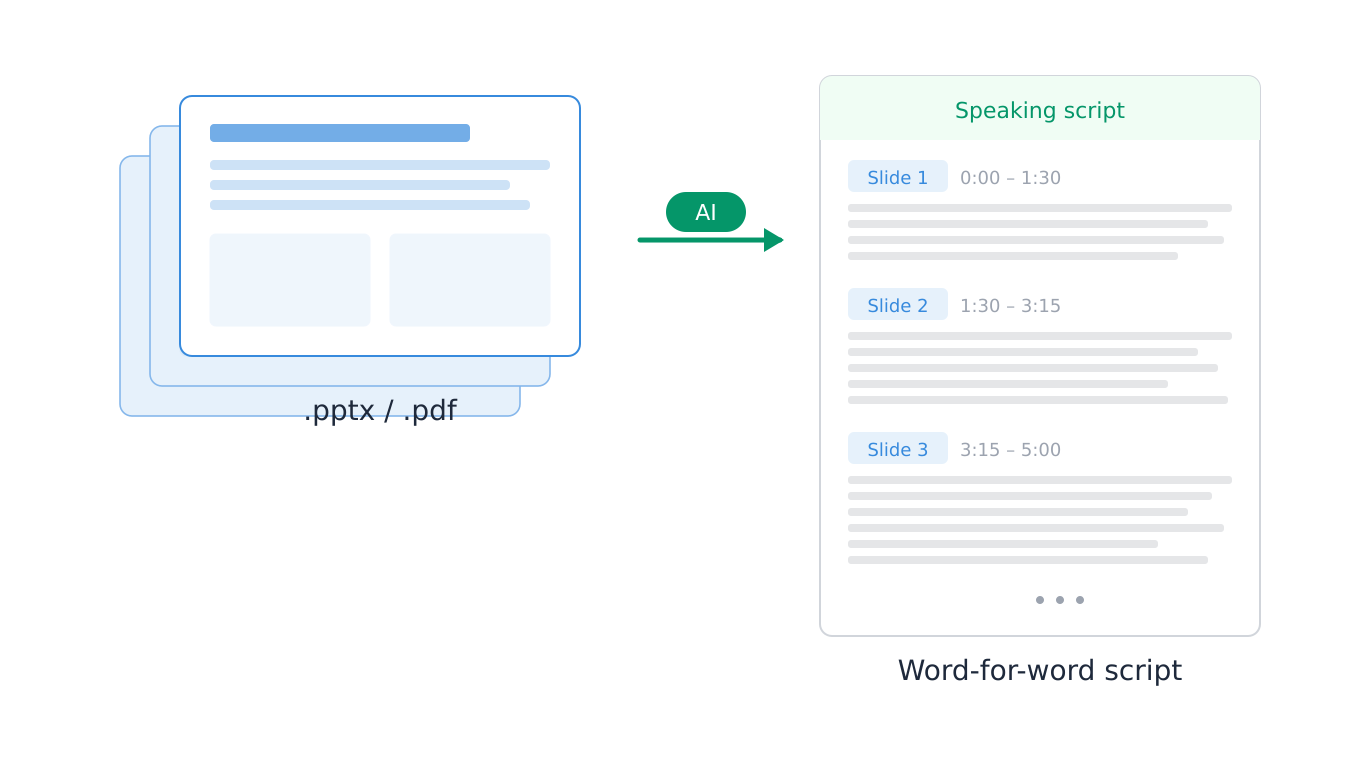
SlideScript takes your existing slide deck and produces a word-for-word script for every slide, timed to the duration you set, in any of 34 languages. What you get back is a complete draft rather than an outline, which means you can go straight to the work that actually matters for you: swapping out the words you cannot say, splitting the sentences you cannot finish, and marking up the pronunciation cues that are specific to your own mouth.
That is the right division of labour. A tool can give you sentences. Only you know which ones you can deliver.